When a programme needs assembly in mainland China, the shortlist almost always reduces to three names: JCET (长电科技, 600584), TFME (通富微电, 002156) and Huatian (华天科技, 002185).
Treat them as different tools rather than interchangeable suppliers. Their technology platforms, site specialisations and customer concentrations differ enough that the right choice depends on what your part actually needs. Market share figures circulating in secondary coverage disagree substantially, so they are given here as ranges with a clear verification status rather than as settled numbers.
JCET — Broadest Platform Coverage
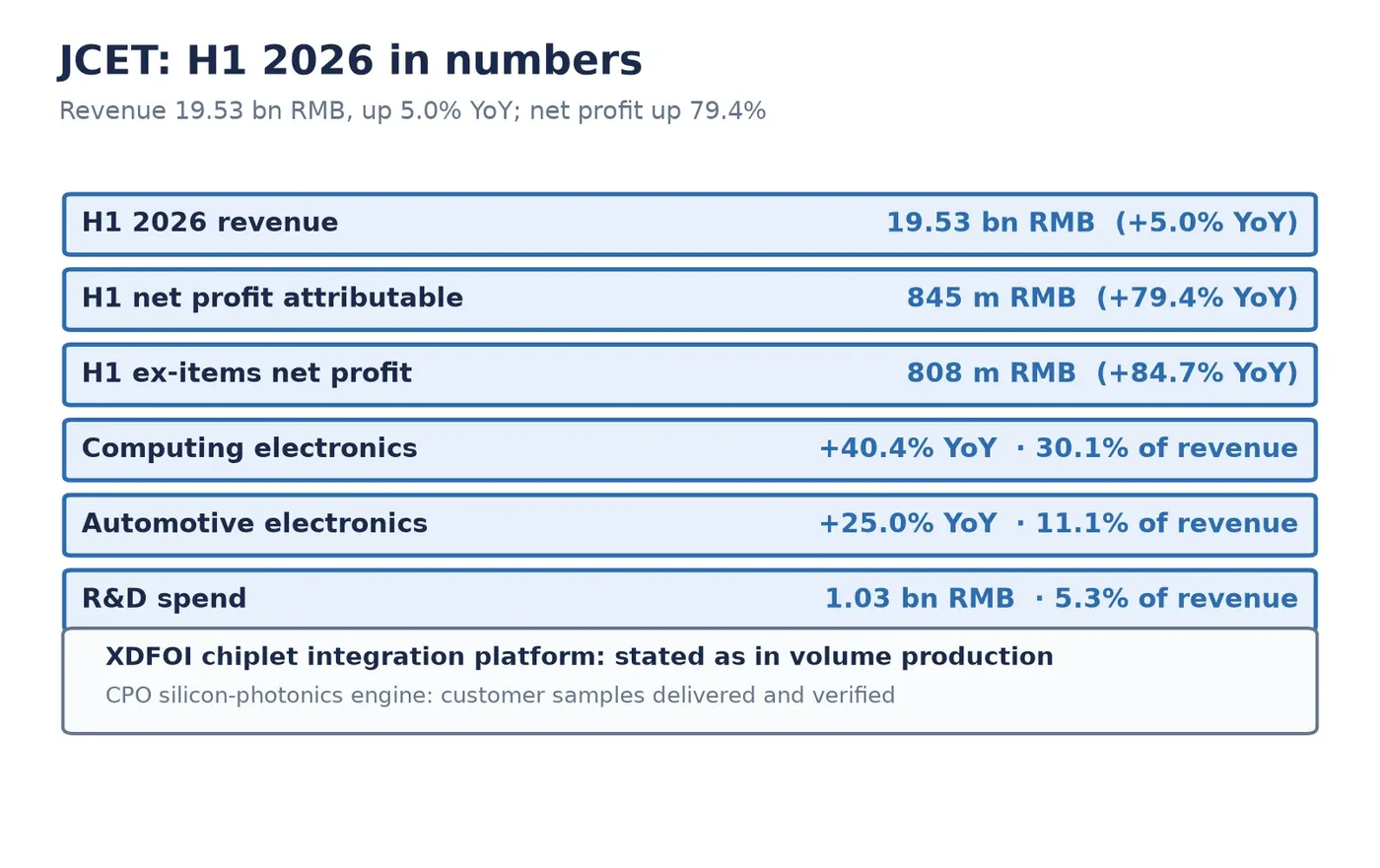
JCET is consistently described as the largest mainland OSAT and among the top three independent assembly and test providers globally. Its distinguishing asset is a self-developed heterogeneous integration platform, XDFOI, reported to span 2.5D, 3D stacking, HBM stacking, fan-out wafer-level packaging, FC-BGA and co-packaged optics.
That breadth is the reason JCET is usually the first call for a programme that is not yet sure which advanced route it will land on. The practical trade-off is queue position: broad capability attracts broad demand, so smaller programmes compete for attention against very large ones.
Reported gross margin is around 14–15 per cent, described as mid-range for the sector and reflecting the capital intensity of the model.
TFME — Concentrated on High-Performance Compute
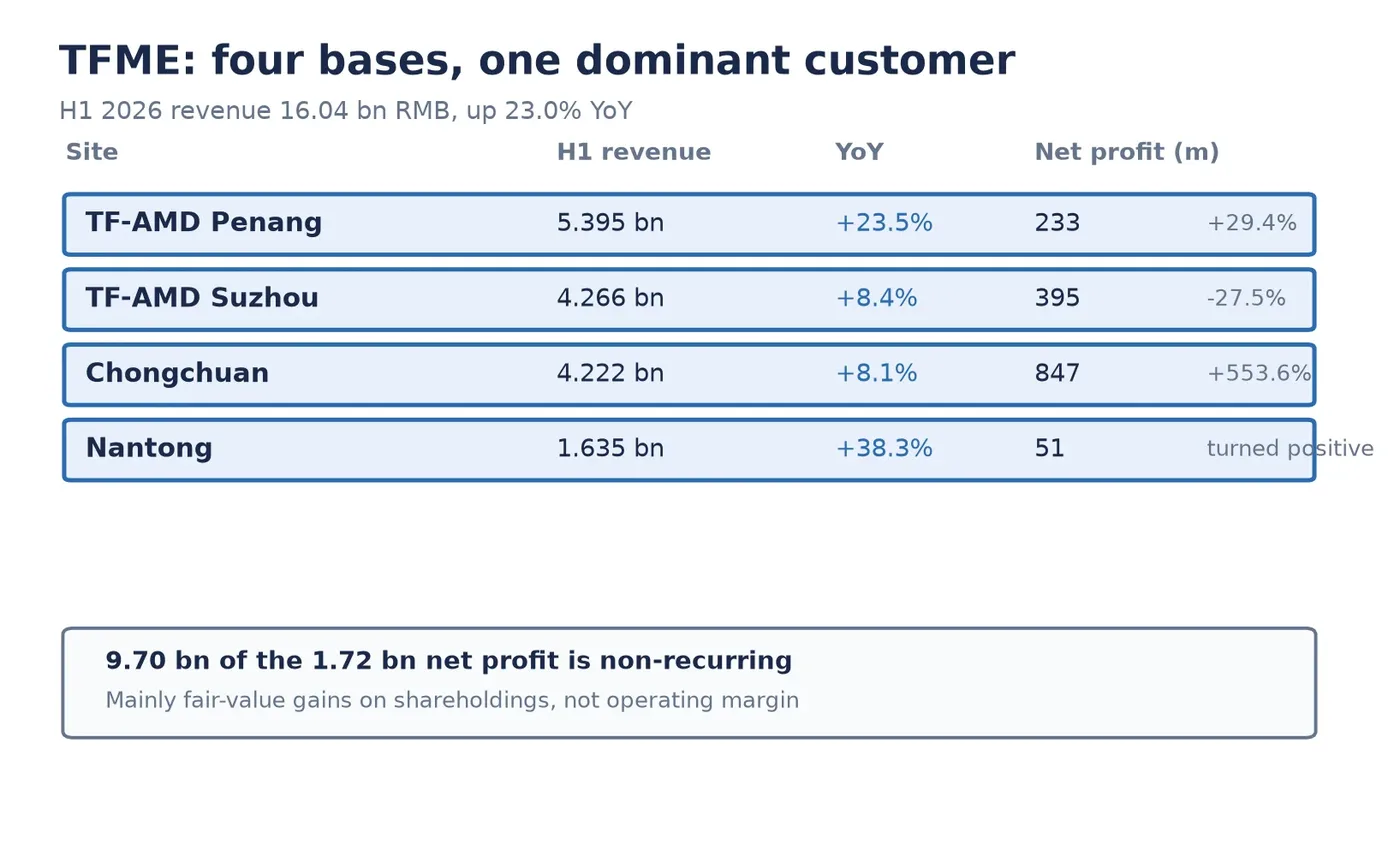
TFME is the second-largest mainland OSAT and is most strongly associated with large-body FC-BGA for server and AI compute parts. Its Suzhou, Hefei and Malaysia sites are reported as the high-end bases carrying that work.
The defining characteristic is customer concentration. AMD is repeatedly reported as its largest customer, with the share of revenue attributed to that relationship reported at materially different levels across sources — figures around half of revenue and around 70 per cent of certain orders both appear in secondary coverage. Both are recorded here as reported, not verified.
On technology, TFME is reported to have a 3D stacking platform, with chiplet, 2.5D and HBM packaging at sample or customer-validation stage rather than stated as mature production. Reported gross margin is around 14.6 per cent.
- Strength is large-body FC-BGA for compute, not breadth across every package family.
- Customer concentration cuts both ways: deep process maturity, but less schedule flexibility for smaller programmes.
- Confirm which advanced routes are production-qualified versus in validation before planning around them.
Huatian — Cost Discipline and Automotive
Huatian is the third of the three and is generally positioned as the cost-focused option with strength in automotive-grade packaging. Its four bases are described with clear division of labour: Kunshan on FC-BGA, fan-out, wafer-level and SiP; Nanjing and Xi'an on memory, image sensors, power and automotive.
It is described in secondary coverage as a leader in domestic TSV packaging, with cost control and net margin cited as better than peers, and with advanced packaging described as a rising share of its business.
For programmes where unit cost dominates and the package requirement is established rather than exploratory, Huatian is usually the one worth quoting alongside the other two.
Market Share: Why the Numbers Disagree
Published domestic share figures for these three conflict substantially between secondary sources. JCET appears variously at roughly 30 per cent, around 29.7 per cent and 36.9 per cent of domestic packaging and test. Huatian appears at about 9.9 per cent and about 14.1 per cent. Shares of the domestic advanced packaging market are given on yet another basis again.
These come from aggregator and financial-media coverage rather than from company filings, and they use different denominators — total domestic packaging and test versus domestic advanced packaging, revenue versus capacity. They are recorded here as **待核实 (pending verification)** and should be checked against the companies' own reported results before use in any commercial document.
- Domestic packaging and test share, JCET: roughly 30–37 per cent depending on source — pending verification.
- Domestic packaging and test share, Huatian: roughly 10–14 per cent depending on source — pending verification.
- Advanced packaging as a share of each company's revenue: figures between 30 and 70 per cent appear across sources for different companies — pending verification.
How to Choose Between Them
The decision is usually made by three variables: what the package form factor demands, how concentrated your supplier already is, and where you sit in their queue.
- Unsure which advanced route you need, or spanning several: start with the broadest platform, which is JCET.
- Large-body FC-BGA for compute with high volume: TFME's process maturity on that specific work is the reason to quote them.
- Cost-sensitive, established package, automotive or sensor content: quote Huatian and compare on total delivered cost.
- Always get a second quote. Concentration risk is real on all three, for different reasons.
- Ask which routes are in production versus validation. That answer changes your schedule more than any share number.