Instruction-set architecture comparisons are easy to find and rarely decisive. What decides the choice in a real program is software, and secondarily licensing and qualification evidence.
If your team already has a toolchain, an operating system port and a body of tested code, that is usually worth more than any architectural difference.
Start From the Software
Compilers, debuggers, RTOS and OS ports, drivers and middleware represent most of the effort in bringing up a processor subsystem. Reusing an ecosystem your team already knows removes months of work and a class of bugs.
If your product ships firmware that must be maintained for years, the availability of long-term toolchain support matters more than the core's benchmark numbers.
Licensing and Cost Structure
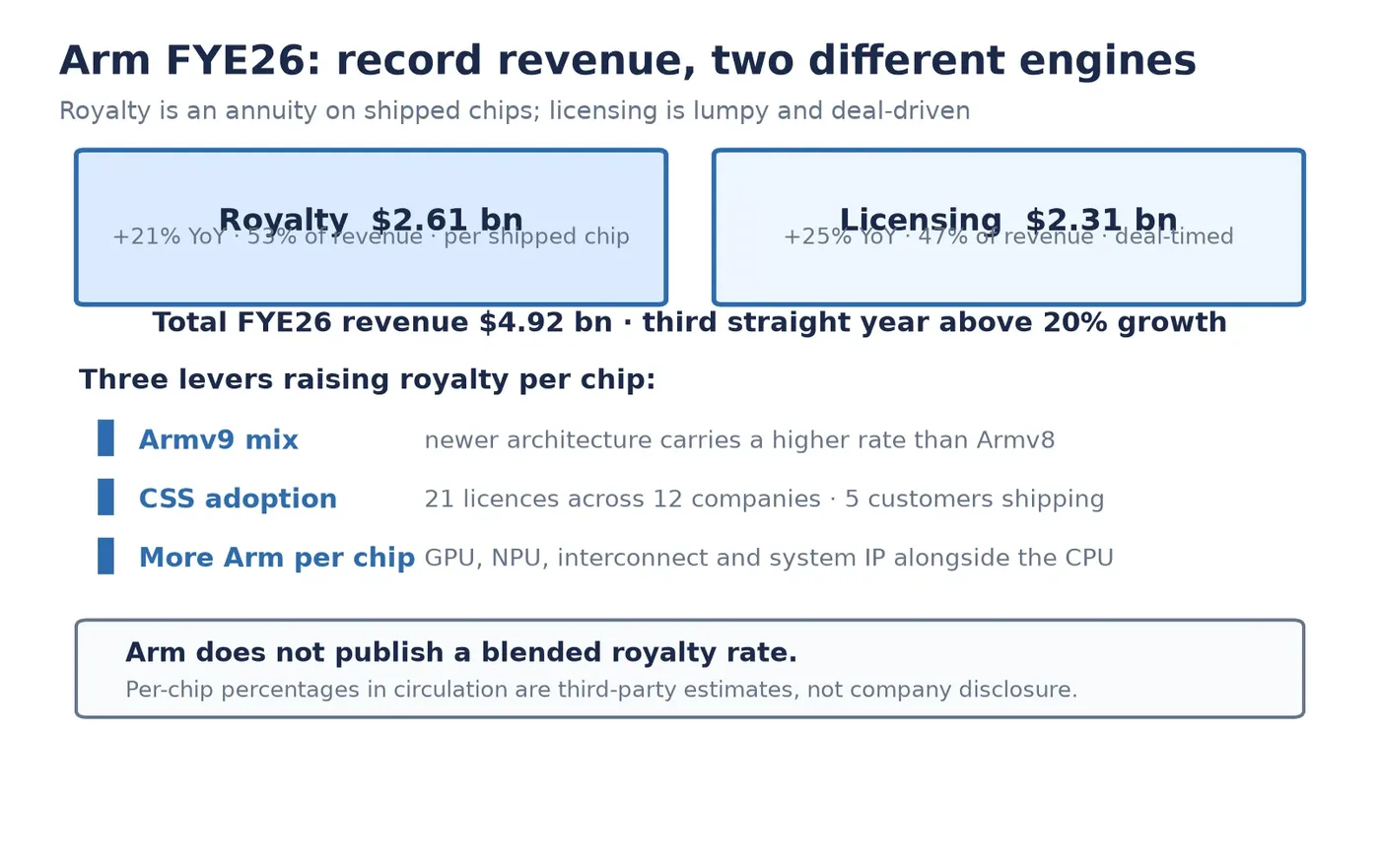
Commercial cores typically carry an upfront licence plus a per-die royalty, with tiers and caps negotiated by volume. Open instruction-set implementations usually remove both, shifting cost into internal engineering.
The comparison should be total cost of ownership across the volume curve, including the engineering time to integrate, verify and maintain. At low volume the licence route is often cheaper; at high volume the arithmetic can flip.
- Commercial: licence fee plus per-die royalty, vendor-supported
- Open ISA: no royalty, but you fund integration and maintenance
- Compare across the lifetime volume, not at one point
Verification, Safety and Security Evidence
For automotive, industrial or security applications, what you need is evidence: a qualified toolchain, documented verification, fault-injection and safety analysis artifacts, and a vendor willing to support an audit.
Commercial processor IP usually ships with that evidence as a product. Open cores can be qualified, but your team produces and owns the evidence — and the audit support that goes with it.
Performance and Customisation
Where a workload is genuinely custom, the ability to add instructions or tightly couple accelerators can matter. Open ISAs are designed for extension; commercial cores offer configurability within a defined envelope.
Be realistic about how much customisation you will actually maintain. A custom extension that outlives the engineer who wrote it is a liability, not an asset.
Where Each Tends to Win
Commercial cores tend to win where software ecosystem, safety evidence and vendor support dominate, and where time to market is the binding constraint.
Open implementations tend to win where cost per unit is the binding constraint, where the team has RTL and verification capacity, and where the software story is already under control.